
In my role as a Senior OpenShift Technical Account Manager at Red Hat, I focus on mission-critical stability; helping organisations navigate the shift from cloud-native architectures to AI-ready operations. But there is a distinct difference between advising on a scalable MLOps workflow and trusting a local LLM to trade your own capital in a volatile market.
Would you trust an AI agent with your bank account? I did; and it was a masterclass in ‘Boom or Bust’ logic.
The Stack: Local, Lean, and Agentic
I wanted this to be an exercise in efficiency; running local inference on a modest nVidia 3060 rather than relying on expensive proprietary APIs.
- The Brain: A quantized Qwen-14B model.
- The Interface: OpenWebUI for API orchestration.
- The Engine: A Python core utilising CCXT for Kraken exchange integration.
- The UI: A custom Flask dashboard and SQLite for persistent trade history.
The Iterative Leap: From “Child-like” to Strategic
The most fascinating part of this project was the evolution of the agent’s logic. Initially, it appeared “child-like”; following basic instructions to identify dips and peaks with literal precision, yet lacking any broader strategy. It ignored exchange fees and “flash wicks,” leading to a portfolio that was slowly but consistently decreasing.
The breakthrough came from refined agentic workflows. By feeding the agent a more sophisticated market context; specifically the 6-hour range, average volume, and a strict “1% safety buffer”. I moved it from “blindly following rules” to strategic reasoning.

Measurable ROI
The results were immediate. By forcing the agent to calculate its “Break-Even Price” (including fees) and “Strategic Exits,” the portfolio shifted from a steady decline to slow but consistent growth.
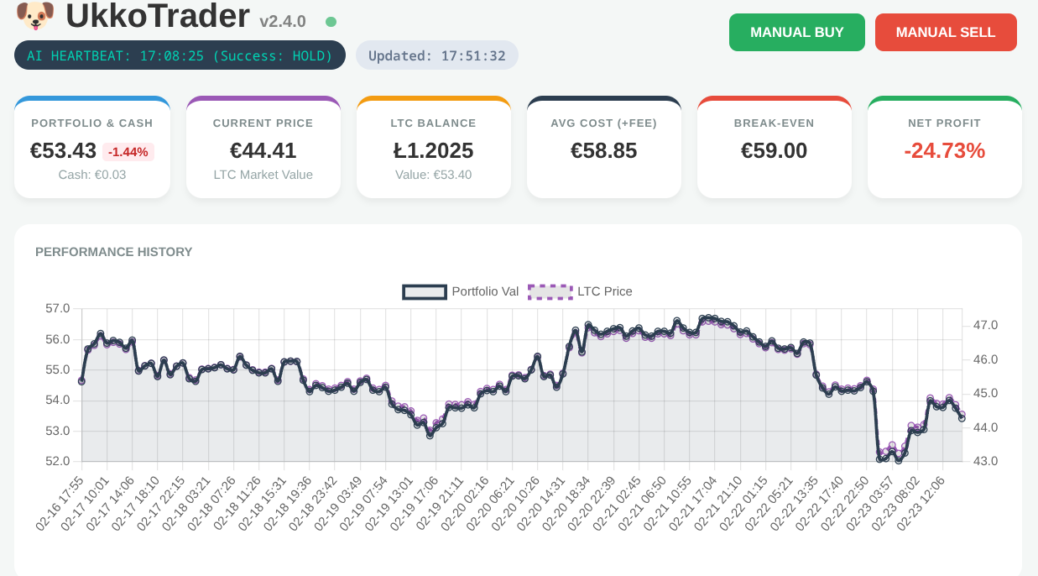
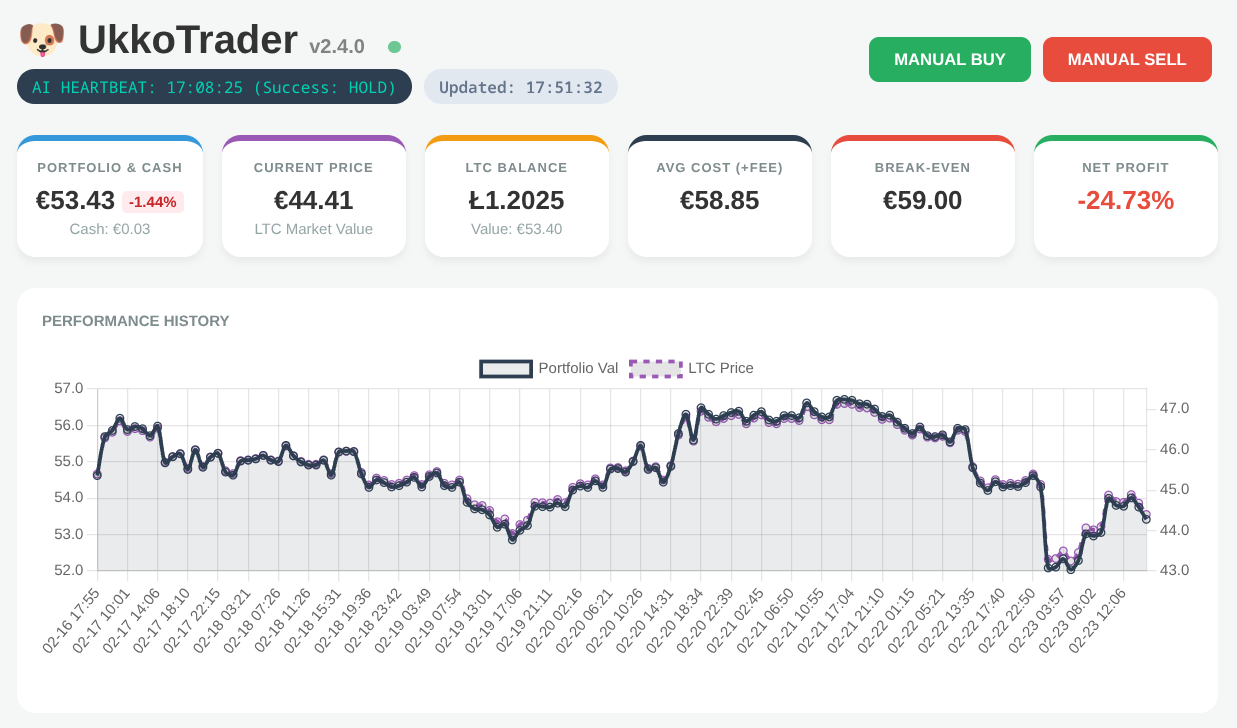
A note on the dashboard: While the dashboard currently reflects a -24% net loss (the ‘historical debt’ from the agent’s early, unrefined phases), the current strategy is one of patient accumulation. Despite recent crypto market volatility, the agent has successfully avoided panic-selling during the crash. Instead, it is currently ‘Holding’ after making its most recent purchases ‘in the dip’; protecting its capital while positioned for the next market recovery.
We often talk about LLM “hallucinations” but in trading, a hallucination is just a bad trade. By refining the deterministic guardrails within the system prompt, I’ve moved the agent from a naive follower to a strategic mean-reversion specialist.
Why this matters for the Enterprise
UkkoTrader has reinforced my belief that the future of AI isn’t just about the largest models; it’s about token efficiency and the capability of small, local agents. If we can teach a 14B model to manage a high-stakes portfolio on consumer-grade hardware, the implications for autonomous enterprise automation, from environmental monitoring to infrastructure optimisation – are immense.
I’ve always been fascinated by how digital intelligence can solve physical world problems. Whether I’m ensuring an OpenShift cluster is production-ready for a client or tinkering with autonomous agents in my home lab, the goal remains the same; finding robust, practical ways to integrate emerging technology into the fabric of everyday life.
#AI #OpenShift #RedHat #MLOps #AgenticAI #CryptoTrading #LocalLLM #Python #OpenSource